The Root: Is It Really Cheating If There's No Sex?

"How often are affairs nonsexual? I've dated married women before. Two relationships were not sexual -- not because they didn't want it but because I wasn't interested." --F.T. Wow. I'm sure the husbands of the two women you didn't have sex with appreciate your lack of carnal interest in their wives. But you don't get any kudos, sir, for knowingly "dating" married women. The nonsexual relationship you allude to is most often referred to as an emotional affair.

In David J. Moultrup's book Husbands, Wives & Lovers: The Emotional System of the Extramarital Affair,he defines it as "a relationship between a person and someone other than [their] spouse [or lover] that has an impact on the level of intimacy, emotional distance and overall dynamic balance in the marriage." Even though there's no sex, the relationship you describe can be just as devastating to a marriage as sexual infidelity.

Unfortunately, the frequency of emotional affairs is hard to accurately quantify because few people confess, even anonymously, to an affair of any kind. Nevertheless, some reports say that emotional affairs are on the rise, thanks to the convenience of technology and the plethora of social networking sites that keep everyone so connected.

There's also the troubling issue of people who think like you do, who are having emotional affairs and rationalizing that what they are doing couldn't be so bad, since it's not as if there's sex involved. This could not be further from the truth.

Did these wives tell you things they didn't tell their husbands? If their husbands knew about you, did they downplay the relationship by saying "He's just a friend"? Did these women look forward to spending time with you more than they did their husbands? If you answered "yes" to any of the above, then you were having an emotional affair.

An emotional affair doesn't come with the pesky risks of sexually transmitted infections and pregnancy. But just like a sexual affair, it contains deception, secrecy and a breach of trust. You know those times when you wooed married women over cozy dinners or long walks by providing a listening ear and "just" allowing them to be themselves, with no judgment? In those moments, you were robbing a husband somewhere of his wife's feelings, time, interest and concern. You were a participant in stealing the soul of a marriage.


Read more: here

The Root: Does My Hair Texture Affect My Dating Life?

"I took a break from dating, which inspired me to go natural. My head full of big kinky hair gave me confidence again! But now that I want to date again, nothing's happening. My cousin says it's because black men may be 'intimidated by an Afro.' Any truth to that?" --E.C. I won't pretend for the sake of being PC that there aren't men who won't be into your natural hair. There is a healthy chunk of black guys who prefer (for various, complicated and lengthy reasons that require a separate response) for a black woman's hair to be straight. "Some men fall subject to the brainwashing that the media does and have this notion that 'good hair' is flat, long and straight," said a man I asked to offer a guy's perspective on hair. "It's the lack of appreciation of the natural hair of our forefathers, parents and themselves."

Additionally, some of those men will equate your hair texture and style with being, as one friend put it, "militant, competitive, feminist or argumentative," all traits that can be a turnoff when it comes to dating. But that's not who you're looking for. There are enough hurdles to work out when it comes to pairing off, and trying to convince someone to accept the hair on your head just isn't a battle worth fighting. You want someone who appreciates what you're bringing -- in your heart and via your follicles -- and thankfully, many men do.


You don't have to take my word for that, though. I asked the Male Mind Squad -- my go-to group of 50 guys who meet my standard of "good dude" and have allowed me to pick their brains over the years on topics such as women's very personal grooming, why a woman carrying condoms in her purse is a turnoff and what men mean when they talk about a woman "submitting." These guys are raw, candid and incredibly insightful, and except for one, they all agreed that a woman rocking natural hair is of very little concern and not remotely intimidating, at least not to a man who appreciates a confident woman.

In an effort to unload the politics of black hair, I don't think hair texture should be interpreted as sending messages. But if it must, you'll be happy to know that many men interpret your natural hair as a sign of self-love. "It shows that the black woman is no longer buying into what society has deemed 'beautiful' and owning who she is, what she is and what she looks like," said one guy. Another thought that natural hair showed a sign of "fearlessness." He added, "Often, I feel as though women hide behind their weaves and lace fronts."


Read more: here

Essence: Domestic Violence isn't "Sh** Happens"

Back in September 2010, Josie Harris, the mother of three of boxer Floyd Mayweather’s children, filed a restraining order against and accused him of breaking into her home, attacking her by pulling her hair, throwing her to the floor in her living room and punching her in the head as two of the pair’s three children watched. Mayweather also threatened to kill Harris and her boyfriend. That December, Mayweather pled guilty to a charge of felony battery and pled no contest to two counts of harassment. He was sentenced to six months in jail with half the term suspended. (He served two months.) Harris has been quiet about what took place between her and her ex — until now. Over the weekend, she spoke to TMZ about her relationship with her ex, now engaged, and the incident that landed him in jail.

"[Floyd] loves his kids and is a great father,” Harris said. “He would never do anything like that again... I'm sorry the situation happened... now we will just progress and start over and move forward together."

She added, "S**t happens. I'm not mad at him at all... I love Floyd to death."

Harris is entitled to feel anyway she wants about her ex. I applaud her noble ability to forgive him, release any anger she may have felt, and move on with the job of co-parenting. I’m not even mad that she loves him — the heart feels what it does. But I am taken aback by her calling him a “great father” and her seemingly cavalier dismissal the brutal incident that took place in front of their children. Great fathers don’t beat the mother of their children, and especially not in front of the children.


Read more: here

Clutch: Everyone Doesn't Get to Live the Dream

It’s timely for me that The Cut would broach the topic of how interns are treated. My latest one, my third, started on Monday. With her arrival, I’d been thinking about writing an essay called something like “How to Train and Treat Your Intern”. I planned to solicit stories from all my friends – anonymous, of course—about their experiences and how bosses could improve. I thought is necessary since most who have help are not given formal training on what to do—or not. Interns get treated pretty much however the person they are working for was— good, bad, and at times, super ugly. But then Kayleen Schaefer wrote a fascinating story about former Harper’s Bazaar intern Diana Wang who is suing the Bazaar parent company, Hearst Corporation, for violating federal and state labor laws since they did not pay her for her work. Her attorneys want Hearst to pay its former interns “back wages, overtime, and other damages.” Her suit, has become a class action one. My idea, went to the  back burner.

Wang described her four-month internship as a “horrible” and “outrageous” experience. She worked five days a week from 9AM to 8PM and her pretty standard duties were to “track the thousands of purses, shoes, and pieces of jewelry lent to the magazine for photo shoots. She managed as many as eight other interns, sending them on 30 to 40 errands a day, and helping them file expense reports. She answered the accessories director’s phone, writing the caller’s name and holding it up, so her boss could decide whether or not to take the call.”

Her tales of woe include the night she stayed late at the office after everyone left to unpack “a trunk full of accessories, tissue-wrapped piece by tissue-wrapped piece, to dig out a single misplaced necklace. Or the practical agony of getting through a subway turnstile with seven shopping bags in her hands. She chafed at tasks unrelated to the magazine’s operations, like hand-delivering new outfits to editors between Fashion Week shows.”

Despite her “E” for effort, Wang was not offered a job at the end of her internship, and her editor declined to write a recommendation, which means Wang wasn’t so great at her duties or her editor was straight up evil. Both are possible.  Hearst has derided the lawsuit as “without merit.”

Why? Probably because what Wang describes is a walk in the @#$%ing park.


Read more: here

Essence.com: Leave Gabby Douglas' Hair Alone!

On Tuesday, 16-year-old Gabrielle “Gabby” Douglas led our women’s gymnastics team to a gold medal, the USA’s first since 1996. The bouncing, bubbly superstar will also be competing for the gold again today, one of just two Americans chosen after she outperformed media darling Jordyn Wieber, whom everyone expected to land a top spot. But instead of collectively celebrating her accomplishments on the Olympic stage —‘cause I know like you know we always root for the Black girl to upstage the competition — Gabby has been dogged with cruel criticism. Too many folk aren’t discussing her awe-inspiring leaps, bounds and accomplishments. Instead, it’s her hair that has become the topic du jour of some less-than-pleasant viewers.

No, it’s not runway-ready. But Gabby isn’t strutting a catwalk, so why does it need to be? She’s an athlete, competing on the world’s largest stage for the world’s greatest accolades. Did you catch that? She’s not just a champion of her block, or her borough, or her county or state. She’s one of the best in the world, as in all of Earth and womankind. At 16. Her hair may not be flawless, but her gravity-defying performances have been doggone close.

In the same way the phenomenal and oft-winning Williams sisters are dressed down for their colorful and sometimes skimpy attire, Dear Gabby has been blasted over an un-slicked ponytail. And I just don’t get it. Not only is it dead wrong to talk about a child, but I don’t understand why, with all she’s accomplished, her hair is even up for discussion. A gold medal trumps a fresh wash-and-set any day.

Read more: here

Clutch: In Defense of Light Skinned Girls

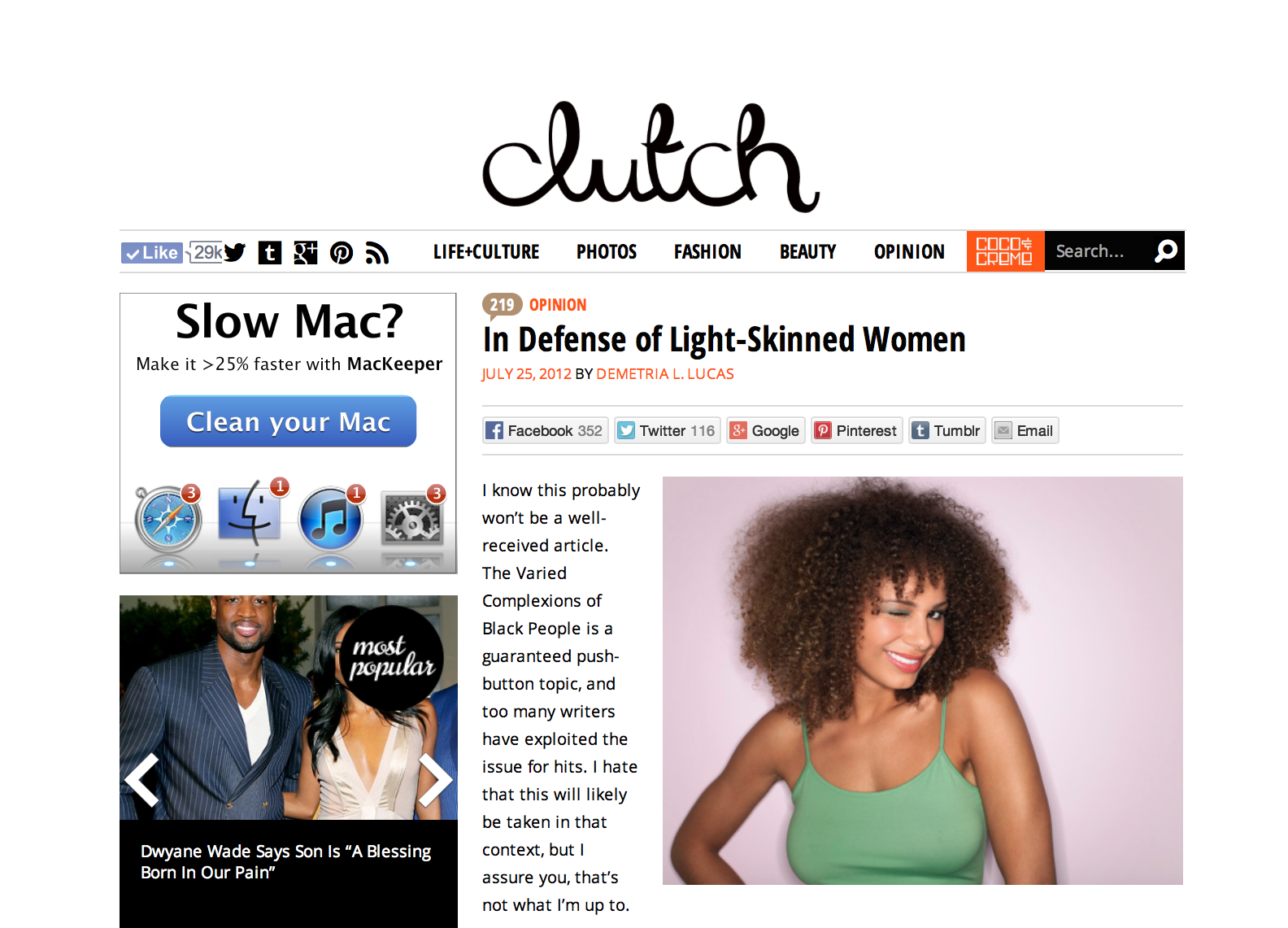
Screen Shot 2014-01-03 at 4.54.49 PMI know this probably won’t be a well-received article. The Varied Complexions of Black People is a guaranteed push-button topic, and too many writers have exploited the issue for hits. I hate that this will likely be taken in that context, but I assure you, that’s not what I’m up to. Hear me out to the end.

When I caught wind of Eric Benét’s latest single “Redbone Girl,” my first thought was “oh, #$%^!” I wasn’t excited; I was loathing the term for the description of light-complexioned women and more so, the comments sections of multiple sites that would inevitably explode with vitriol and knife-twisting in never fully healed wounds. No one man should have so much power.

We’ve all experienced our fair share of unwanted and offensive commentary about our complexions. We say the comments don’t matter and that we’re so over it, but our reactions show otherwise. The emotional trauma, whether you’re 27 light, 1B dark, or a middle shade like 6 brown, all sticks like balls of track glue. What I want to suggest to you here is there is no outdoing each other in the pain category.

A dark girl encounters ignorance about her complexion? Yeah, so does a light girl. It would be nice if she could get a little empathy and understanding, too. Pain is just, well, painful, period. Who’s Hurt More isn’t part of the upcoming Olympics, and the re-telling of emotional battle scars shouldn’t be a competition.

Undoubtedly, racism, sexism, and alleged “preference” have created an unfair culture in which women with lighter complexions can be more valued in some circles. If you dig up stats on incarceration, employment, and even marriage or familial favoritism, they often tend to pan out in the favor of a “light bright.” That’s not at all OK, and I don’t have any Kumbaya answers for how to recondition 500 years of mind-@#$%ing to make it right.

Because in some situations those of a lighter complexion might get a one-up, that doesn’t discount the many ways in which it can be also be a pain. The hue that can make light-skinned women prized among some also can make them loathed among others. And the latter half of that dichotomy shouldn’t be dismissed because of the former.

The vitriol hurled at a darker woman for being melanin-infused doesn’t somehow trump that of a lighter-hued woman, also marginalized but in her case for not being considered black “enough.” (There’s a reason that after a trip to the beach, you’ll catch some light women extend their arms beside another light friend as a playful competition to see who’s finally darker. Sometimes you’ll catch one measuring her skin beside that of a brown friend to see if her complexion made it to brown status. It’s a joyous occasion to be “black enough.”) The words are different, but the intentional infliction of shame, the feeling of being outcast and set apart for something out of your control hurts just the same.


Read more: here

Clutch: 7 Signs He Wont' Make A Good Husband

I read an article yesterday: “7 Signs You Might Not Make a Good Wife.” It was another to add to the expansive list of “Hey, Black Girl, This Is What’s Wrong With You and Why You’re Not Married” stories. Sigh.

For anyone whose ever had a breakup, tried to blame the downfall on their partner, and then managed to discuss it with a level-headed friend, the clichéd advice you heard was probably something like: It takes two to tango. Yes, two. Count ’em — one, then two. That means you, and if you’re hetero, him, too.  Which is why I don’t understand why there is so little dating/relationship material aimed at men. Even men who write about relationships dedicate most of their time to telling women how to be better women. What about the men?

Men can’t just be chilling while women are out here trying to transform themselves into what one of these 50-11 million articles says we should do to snag a may-ann. Not only is not fair, it’s guaranteeing relationships still won’t ever work. It takes two, remember? Two! One, then two.

Does anyone realize that if women en masse ever took all this advice, and collectively got all their ish together, there would still be a huge relationship problem? There’s not suddenly going to be a stampede to altars across America of mature, marriage-minded men springing up from the couch in somebody’s basement where they’ve been biding their time, hosting Madden tournaments or swilling copious amounts of cognac. The problems in relationships will still exist, will always exist, when only one half of the pair has been doing the work to make it better. Anyone currently in a relationship of any sort will tell you that’s not just a headache, but a recipe for imminent implosion. Sigh.

But I’m not here just to rant. Oh no. I’m here to help a brotha out, too. Allow me to offer “7 Signs a Man Won’t Make a Good Husband.” Share it with a man who needs to know.

1. Blames Women for Everything Seventy-two percent of black kids are born out of wedlock. You’d swear women were getting themselves pregnant. The daddy who didn’t even offer to put a ring on it? He must have been run off by an independent women. No matter the subject — the economy, the melting ice caps, global warming — you can be counted on to find a way to tie it back to a woman (and her damn feminism). No woman in her right mind wants to come home to hear that crap. Please sign up for therapy. Now.

2. Is Emotionally Unavailable I get it. Men are socialized to be stoic. No one’s asking you to bawl like a child when you’ve had a bad day at the office, but this whole “I’m just not going to talk/answer the phone; I’m going to drink myself into a stupor” and every time someone asks, “What’s wrong?” you lie and say, “Nothing” is pure-D BS. That, my friend, is a mismanagement of communication skills. Take some time to brood, and then learn how to open up to your partner without thinking it’s a sign of weakness.

3. Doesn’t Know How to Lead Every Indian is not a chief, and every man is not a leader. Having a penis does not somehow grant you the specified skill set and mental capacity to know how to inspire others, i.e., lead. Leaders are not self-appointed and they’re not all talk. They are chosen by the people who believe in them because of their example and vision. If you have no followers, despite your proclamations that you are a leader, you’re no leader. You’re just the boy who cried, “Chief!”

4. Refers to Women as “Females” This is an indication of either your lack of education or social grace. You are insulting half the population with this “female” talk, and you don’t even know it. You don’t deserve to have a wife if you can’t even recognize that an adult human with vagina is called a “woman.”


Read more: here

Clutch: I See White People

I see white people. Usually this wouldn’t be so significant. I live in New York City. They’re not the majority here, but they exist in significant numbers — 47 percent, in fact. These white people that I’m seeing now have caught my attention because of where I see them and how many of them I see doing the unexpected, like getting off the A-train in Brooklyn at Nostrand Ave, cycling at midnight on Franklin, or carelessly walking down Albany and fumbling with their iPhones as they walk in the direction of the projects.

Of course, everyone — and by that I mean the black people who live in my neighborhood — has seen white people before. But that doesn’t stop the curious stares as they ride the train past the stop where everyone expected them to exit (it was Grand Army Plaza, then Franklin Ave. Every two years, the final exit is one stop further), or all the heads that turn — men and women –  watching a pair of white girls in short shorts and sports bras, their real ponytails wagging, as they jog down the street, or the block guys with confused expressions watching the skateboarding Goth teens (read: white) haplessly goofing off on the opposite corner.

I watch the guys, and I think of Lorraine Hansberry’s “A Raisin in the Sun” and realize “oh, this is how they felt — sort of.” Then I think of a story I just read on “Clybourne Park,” a Pulitzer Prize play currently running on Broadway. It’s 50 years later, and the Chicago neighborhood of Hansberry’s make-believe family is filled with black middle-class homeowners, and white people are moving back. I make a note in my iPad to buy tickets.

Gentrification, that hazy mix of capitalism, race, and class that wreaks havoc or at the very least significantly changes existing communities (depending on your perspective) has come to yet another Brooklyn neighborhood — and fast. Of course, it’s not the white people who are the problem. Nor is it a fear, hatred, or some passed down DNA flashback to the Door of No Return that makes some black folk resistant to their arrival in their communities. lt’s the knowing of what’s to come because of what came in others. The arrival of people with more disposable income leads to building owners charging more rent, to bodega owners charging higher prices, to the businesses you frequented closing and opening up as someplace shiny and new, and eventually to the displacement of residents who’ve called that particular neighborhood home because they can no longer afford to stay.

As soon as the building of the Barclay's Stadium in downtown Brooklyn became a serious consideration, people began to either fret about or rejoice over what would happen in my Crown Heights neighborhood — the still “black side” of Brooklyn where gentrification on the of-color side Eastern Parkway seemed like a trickle. I did a little of both.

Read more: here

The Root: How Many Men Have You Slept With?

"I know you don't believe in discussing how many sexual partners you've had with someone you are dating, but what about if you are about to get married? Is that something that should be known -- or, if your partner wants to know, should you discuss it?" --S.V. I'm not a fan of disclosing your number under any circumstances, and though it's a popular question, I can't believe that anyone over the age of 18 still asks anyone how many people he or she has slept with.

In the same way that many women assume that a man must be a "good catch" if he has a degree and earns six figures, or in the way that many men assume that a woman is "wife material" if she can throw down in the kitchen and fixes his plate, many people -- more so men -- also assume that a person's "number" is indicative of his or her morals, values and worth as a partner. And it's just not accurate.


The answer to "How many people have you slept with?" doesn't really give you any useful information. The answer from a 40-year-old woman could be three. That's harmless enough, but it doesn't tell you if the men were all serious relationships, if any of them were married or if all three encounters occurred in some wild ménage à trois (plus one) the week before, and one of the participants was the would-be best man at the upcoming wedding.

For a woman, there is no right answer, and any answer is likely to be used against her, which is why I suggest you don't answer. No matter how tame her past may be in comparison with that of the man asking, she's likely to be looked down upon in some way -- even if she's a virgin. It's slut-shaming at its finest.

It's no secret that our culture holds men to a different and more liberal sexual standard than women, or that many men take advantage of that double standard. If a guy is answering the question, no matter how high the number, it's usually dismissed with a shrug under the guise of "Well, boys will be boys."

A few months ago, I participated in a roundtable discussion for Essence magazine's February 2012 issue with the leading relationship bloggers, including The Root contributor Damon Young of Very Smart Brothas, Anslem Samuel from Naked With Socks On, Jozen Cummings of Until I Get Married and Charli Penn-Watkins from Man Wife and Dog. Cummings actually applauded women for being more mature for not caring as much about numbers. I had to inform him, "That's not a sign of maturity. It's an understanding that if women were to start rating men the way they rated us based on how many partners they've had, there may not be very many men to date."


Read more: here

The Root: What Can I Do to Make Him Upgrade Me?

What should I do about a guy friend I really love and care about -- and I know he cares for me -- who has said he doesn't see me as his life partner? I am heartbroken and at a loss for words. Other folks see what I see whenever we are together. Should I say something again or wait on him? --H.B. I'm sorry to hear that you are in pain, but don't allow your grief to cloud your judgment. The person you care so much about has made it clear that he is not interested in pursuing a relationship with you, much less marriage. He has been up-front and, so it seems, upstanding. And he has made a decision about what he wants. What "other folks" think or see, and even what you think, doesn't matter. No means no. Respect his candor and his feelings, and also keep a little of your pride by not pushing this issue any further.

You seem to have invested a lot of emotional energy into this friendship and have become a bit deluded about what was occurring between you and him. You note that you love and care about him but describe how he "cares" for you -- no mention of love. This points to an imbalance in the feelings between the two of you.

You are also "at a loss for words" over a man telling you he doesn't want to spend his life with you. I'm curious why you even thought he would. He was "only" a friend, not even a boyfriend. If he had not committed to the foreseeable future and did not love you, as you implicitly acknowledge, what made you think that he was remotely interested in forever-ever?

The options you suggest for dealing with this issue won't only strain the existing friendship; they will also embarrass you and leave you further depleted in the long run. Often how this scenario plays out is the guy flat out rejects you again, which means he's actually doing you a favor. Or, worse, he occupies his downtime with you despite not wanting a full-blown relationship, and you continue to pursue his affections. This is a mistake that many women make while dating, one that can lead to bitter spirits and broken hearts.

You're painting yourself into a gray area. He's not entirely right for accepting your ego-stroking attention or bed-warming affection, but he's not exactly wrong, either. After all, he's done his part by telling you what the situation is -- that it's nothing serious and going nowhere -- and as you continue to pursue him, you're tacitly accepting that you're OK with that arrangement.


Read more: here

The Root: Have You Ever Snooped on A Mate?

I went through my boyfriend's phone and found out he's been talking to his ex-girlfriend, who he told me he hadn't been in contact with. He's calling her pet names like "babe" and "sweetheart" -- the same things he calls me -- reminiscing about their past sex life, and the phone log shows they've been talking a lot and they've met up at least once. Last Friday I was calling him and he didn't answer his phone. He told me he'd left it at home by accident, but his texts indicate he made plans to go to dinner with her. I want to confront him, but I don't want him to know how I found out. Help! --A.D. Often when you go looking for trouble, it's trouble that you find. You thought your boyfriend was up to something, and unsurprisingly, he is. You've found proof that he's been lying to you about being in contact with his ex and his whereabouts, and that he's been cheating on you.

What you call a meet-up is actually a date with his ex; call it what it is. The cute names he calls her and "remember when" conversations about their sex life indicate that either she's Girlfriend No. 2 or, at the very least, he intends to make her a bed buddy again, if she's not already.

I'm no fan of snooping, even though lots of people have done it. Thirty-three percent of dating couples and 37 percent of spouses -- slightly more women than men -- say they have checked their partner's email or call history, according to a 2011 survey by the electronics site Retrevo.

Among those under 25, almost half reported snooping. Of course, there are various other ways that people go about it, from combing through social networking accounts to adding spyware to computers or tracking devices to electronics, rummaging though drawers or pockets, and even driving by folks' houses to check if the lights are on or off, if their car is in the driveway or if anyone else's is parked nearby.

What all of those amateur private investigators didn't realize is that they could have saved themselves the trouble. By the time it gets to the point where you can't trust your partner, for whatever reason, your relationship is doomed.

Even if you snoop and your partner isn't up to anything, when you get caught, you're now the one violating the trust in the relationship. You'd have been better off talking with your partner about your concerns when you first had them. If you can't get the reassurance or resolution you need through communication, then it's better to walk away and find someone you actually can trust.

Read more: here 

Clutch: My Best Friends Are Black

I don’t like Girls. Revolutionary thought, right? I know. Since the HBO show’s premiere two weeks ago, I’ve read all types of moaning about the show, the story of four twenty-something brown-haired white women making a way and doing slightly better than Florida Evans in seemingly homogeneous Brooklyn. The prevailing complaint about the show has been about all those people of non-color living, mating, and getting by in America’s biggest melting pot of a city. How could it be, many, many (too many) people have wondered, that they couldn’t find any color in Brooklyn?! I mean, besides the homeless Black guy that yelled at “Hannah” to “smile!” (There are people of color in Girls’ world, they just, well, color the margins life for the people of non-color.) In all the Girls talk, there’s emerged a prevailing ideas that New York City proper, with inhabitants that undoubtedly rep every country and city on Earth’s face, is this place where people of all cultures gather around the Empire State Building and do some sort of collective kumbaya chant where we express tolerance for every race, religion, and creed. Nightly.

I’m almost certain where this lure of the New York melting pot came from. It’s a bunch of people from everywhere, living in close quarters, and so in theory, they would all intermingle on more than public transportation and then find common human interests like, you know, surviving this city and become friends. Surely that can happen, but what’s been my experience in application is it doesn’t for a lot of people. Of course, there’s potential for New York to be a melting pot, if you prefer it that way. But it can also be as segregated as a Jim Crow Mississippi, complete with the crazed police brutality, but without the separate but equal signs.

The crowded streets of Times Square look like the figurative UN (all tourists, so you know) and by convenience and for time efficiency, you’ll see people of all colors, including the Mayor, smashed together on the subway come rush hour. But for, dare I say, many New Yorkers, sharing a knowing eye roll across an empty aisle to whomever from wherever when the inevitable kid enters the subway car to sell M&Ms and recite the scripted speech about hustling on the train–”Not for no basketball team, but to have money in my pocket so I won’t be robbing you”–can be as meaningful as your NYC encounter with another race gets.

I will have lived here ten years come late August, and I have just one non-Black friend.

Read more: here

Thoughts on "Not African Enough in Africa"

For some time, I’ve had a policy of not commenting on the posts I write. As a writer, I choose my words carefully, so that each conveys what I intend. Readers may take my meaning from it, or they may not. Each person brings their perspective to the screen and that naturally effects how they receive the message.  I learned many years ago that you can never really tell how a piece will go over with an audience. That said, I’m not at all that surprised that most of  the comments on “Not African Enough in Africa” were, well… such a clusterf**k. Several years ago, I wrote a two-part series about the sometimes conflicts between Africans, African-Americans and Caribbeans. I revealed some less than flattering comments that had been said to me about Americans from some Caribbeans and then spoke of some ignorant things I’d picked up as a child about Africans. Like “Not African Enough in Africa”, that story hit a lot of exposed nerves, revealed some ugly truths and opened many wounds. The comments section got ugly. After hundreds of replies to each post, I closed the comment section just to end all the insults (and not just at me, but at other commenters) and in-fighting. After that, I stayed away from similar topics. I knew the issues discussed were a deep problem. And I didn’t have a solution or see a way of effectively talking it out or through it, especially when, just like the Clutch post, people were reading what they wanted to see, not what was there.  So I figured the topic was better left alone.

I decided to write “Not African Enough in Africa” because it was something that I’d been thinking about, even before I headed to South Africa in January. (As many of you know, I’ve been writing a book about my travels over the last few months, sort of a Black Girl’s “Eat, Pray, Love”.)  Four years ago, a co-worker had returned from Ghana and had a similar experience to the one I would in South Africa, which is to say she loved the country, loved the people, loved the culture, but she didn’t “fit” the way she thought she would. She’d headed from the East Coast to West Africa hoping to see the slave castles and to duck and wobble her way through the Door of No Return, just as, so  the mythology goes,  her ancestors had centuries before. And she did that.

But she’s Black American like me. And though she had her “full circle” moment in Ghana, she’d also over-hyped what her experience would be. She expected to “fit”, not in the sense that an old woman at a market would spot her, hold her face and declare her exact tribe and ancestry (that’s a Black American urban legend, so you know), but that she would sort of blend into the rhythm of Accra. She’d learned the greetings, and the proper way to address elders, the modest way to dress to show respect.

She noticed while she was there that everyone called her a name, one she couldn’t find in all the translation guides she’d brought with her.  Someone finally translated it for her: clear.  She was heartbroken.  She wasn’t some Black American expecting to be “declared Mama Africa” as a commenter on Clutch put it, or as another said, that all of Africa “ stopped living to mourn your loss and will feel this sense of relief when you return.” She expected to fade into the background, to be just another link in the chain while she got giddy in her head about all the Black people everywhere – and in power!-- and go unnoticed.

I approached South Africa a similar way, reading travel guides and books, which had to be searched out. Most American guides to South Africa are about safaris, apartheid museums and if you’re lucky Cape Town. Jozi is snuck in as an international fly-thru to get to Durban or Cape Town. Most of the Jozi information I found was warnings to beware of the great danger and all the places you should avoid.

I’m not sure how the idea that I showed up in South Africa as an “ugly American” took hold, a popular sentiment among commenters. I showed up open, giddy about everything, from driving on the left for the first time to the bookstores that overflowed with magazines that featured Black people on the cover to actually just being in “O.M.G. Africa!” I gushed on Twitter and twit-pic’d to share with my followers. I was frustrated as f*** about the Internet situation—ie, the friend I was staying with didn’t have wi-fi and my AT&T plan, the one I paid extra for, didn’t work on the whole continent. That’s a problem, when you have a story due the following morning, and it’s a stateside problem as well. Other than the chick with the sunglasses, that’s the only thing I was really annoyed by. Everything else was observations and revelations.

More than anything, I just wanted to see people, do whatever it was they did. See as much as I could of  a place that I’d been wanting to go to since I was 10. I watched and observed and when I couldn’t keep my mouth shut, I asked a million questions. An ugly American? Hardly. I was gushing and marveling at near everything, but not everything. I’m not a publicist.

But an American? Definitely. Just like I can spot a New York tourist (or a fresh New Yorker, they’re just too damn nice) immediately, South Africans could spot me as an American.  I can spot a visitor or newbie in the way they move, the details of how they put their clothes together. There’s a South African “style” in the same way one exists for Paris or London or Brooklyn. And I didn’t have it. The same can be said for my features. Some people I met looked exactly like Black Americans, most didn’t. Why would they when they’re not Black Americans? I look like a Black American. I don’t understand why there was contention over that observation.

Maybe I should have gushed more in the initial piece so people who are used to their home – South Africa, or Africa in general-- being shat upon by Americans would know that what I was writing wasn't one of "those" stories. That’s the only reason I can fathom that so many commenters created sentences and sentiments that didn’t exist in what I wrote. As some commenters pointed out, there really wasn't anything to jump to the defense for or go into attack mode over.  I thought about adding some superfluous lines, but I don’t write press releases or travel guides. That also wasn’t the point.

For clarity, “Not African Enough in Africa” was written to debunk the myths that Black Americans are sold about Africa. Not the stuff about it being populated with huts, bloated babies and people chucking spears; a Google search can take care of that. But another myth, one that’s not often talked about, but can really screw people up when they’re dreaming of some place called “Home” like Stephanie Mills and you find out it doesn’t exist.

Many Black Americans suspend logic to imagine there’s a place on the other side of the Atlantic where they “belong” since so many don’t feel that happens here. The desire for a place where you feel like you just are allows for logic to be defied. People do it in bad relationships and over absentee fathers every day. I don’t understand why it’s so surprising in this context.  It’s not logic. It’s not ignorant. It’s hope for something better than the hand you’ve been dealt, an idea that keeps you going much like Christianity’s promise of suffering in life and getting your rewards at the pearly gates. If you don’t have that, then what? (That’s actually where I was hoping the conversation would go. Eh. All good though.)

The mythology and reality that allow for the suspended logic are literally the first 500 words of “Not African Enough in Africa”. The next 700 expose the knee-slapping joke that’s been had on Black Americans who hold up all of Africa and any part of Africa as our specialized Motherland. We’re Americans who are Black and that’s all. The story was in no way an indictment of what’s wrong with South Africa or Africa in general (if I thought it sucked specifically or generally, I’d just say that.) I could have  spoken greetings in all 10 of South Africa’s other official languages (and none of them would have enabled me to answer a question about sunglasses) and I could have been in Ghana or Nigeria, or Tanzania or any other country in the world and I wouldn’t “fit” because squares don’t fit in circles.  That there are Black Americans who are willing to try is an indictment of what’s wrong with America, a problem that I only picked up on when I got to South Africa and realized no, really, this “I’m so American” feeling isn’t just what happens when I travel thru the UK and Europe. That’s really just what I am, no hyphen necessary to pay homage to roots that were severed. My bad, I was bamboozled, maybe I just wanted to be.

Realizing that didn’t ruin my trip though. It didn’t turn me off to South Africa, the continent of Africa or any of Her other countries, a popular yet baffling sentiment in the Clutch comments section that was in no way even implied in the story, especially as I’ve already started hounding a friend to take me to Lagos with him when he goes to visit his fam in December. I loved South Africa, I just won't be  going back there, or any other place, searching for needles in haystacks.

My trip to Africa was the sh**.  I made friends. I went to great parties. I stood in clouds. I saw breathtaking views. I got a song trapped in my head that I still can’t get out. I had a great time that I shared with a lot of people. I liked Jozi so much I looked at real estate. Oh, and I dropped the “African-“ from the way I identify myself. I’d say that’s a great trip.
Clutch: Not African Enough in Africa

When I was 10 or so, my father won an all-expense paid trip to Senegal. “We’re going to Africa!” my mother gleefully exclaimed. So we took the Amtrak train to New York to fly out of JFK and ignored the warnings of a pending Nor’easter, thinking the sheer and desperate determination of three Black Americans to make it to Africa would hold off the worst of the snow until we were airborne. It didn’t. New York City was shut down for three days, and by the time the airports opened, it didn’t make sense to fly out. We pushed the trip back indefinitely, and never made it. And so began my obsession with Africa, the place my even-tempered mother spoke of like it was some sort of Disneyland for Black people.

Some Black Americans, and I’m referring mostly to those that call Mississippi, Georgia, and South Carolina their “Old Country,” tend to be awe-struck at the idea Africa, like Nas at the end of Belly. Once we get a full picture beyond what we’re taught in school, where the largest continent and birthplace of all mankind is reduced to being the starting point for the Atlantic Slave Trade, there becomes an eagerness to migrate back across the Atlantic. The yearning is not unlike some immigrants who seek entrance to American shores. Except we’re not seeking the opportunities and streets of gold that Fievel and his family expected; we’re seeking the “home” that the Middle Passage erased.

I get why. For many American Blacks, the overall American experience has never really felt like a place where you can kick up your feet and recline all the way back. You get moments where that happens, of course, but then you also get a startling awakening— like when people are surprised you don’t have any children out of wedlock, or you happen to be “so articulate,” or despite carrying a purse while you shop, you find yourself explaining “No, no, actually I don’t work here.” Those things remind you not to get too comfy. America is home in the sense of being the devil you know, a bit like a stereotypical step-child, the one you tolerate but don’t really love like your own.

In recent weeks those feelings have surfaced again for many who struggle to make sense of the injustice of Trayvon Martin’s killer walking around freely, the ignorance displayed in conservative columnist John Derbyshire’s piece for The National Review where he wrote of advising his children to avoid Black folk, and the obnoxiousness of those Twitter-racists who found outrage in a sympathetic book character being Black or Awkward Black Girl landing the Shorty Award for best web-series. I find, similar to Cinderella, we dream of an escape to a place where we fit, like a glass slipper on the correct foot. For me, that place was Africa, any country, any part.

Read more: here


Essence: Confronting the Other Woman

Last week's episode of La La's Full Court Life threw me for a loop. I became addicted to the show last season because La La Vasquez-Anthony was a different type of Black woman on reality TV: family-oriented and confident. And though she was very much a basketball wife, she wasn't resting on her husband's laurels. She was a wife and a mother still chasing her professional dreams, and I loved watching her drama-free shine. On the season 2 premiere, though, the show seemed to be upping the conflict factor.  La La called a sit-down with the assistant she had selected to work with her husband, New York Knick Carmelo Anthony. La La asked her if she was sexing him. The answer was a firm “no.”

The encounter stemmed from a conversation La La had with a male friend who questioned La La on whether it was prudent to have such a beauty working with her man, implying that late nights on the road would lead to a more than professional relationship between the two of them. Once that seed was planted, La La’s confidence in her marriage took a hit. The next time La saw her hubby, his assistant in tow, she threw shade at the assistant and kept a close eye on her man.

I sort of get it. The most confident of women have their insecure days. But it was the confrontation that had me saying "Oh, no!" at the screen. I literally cringed.

On two occasions, I’ve received calls from women asking me about the nature of my relationship with their men. One was a wife wondering how my number got in her husband’s phone. She was polite and although I immediately decided she was a nutcase, I put her at ease when I explained he was a friend from college who I ran into when visiting my hometown one weekend. The other was a belligerent woman ringing my phone too early on a Saturday morning demanding to know if her man was visiting me in New York. He wasn’t and I had never spoken to him beyond our initial contact exchange, but I hung up without telling her that. Both times, I marveled at their boldness and wondered why they were calling me and not their men. (Then I contacted the guys to let them know that they were with crazy ladies, in case they were unaware. I added that they should delete my number for their own use as well.)

I'll be the first to say that if you have a question, ask. No sense in assuming or denying while driving yourself crazy. But it was whom La La, and the ladies who called my home, asked, not what.

Read more: here

The Root: Fear of A Successful Black Woman?

The "men are intimidated by successful women" story is always touted as a reason many women are single. I didn't believe it at all until it sort of happened to me recently. I'm in my early 20s, not discouraged but shocked. What's your experience and take on this? --T.D. The truth about partnering is that the more educated you are, which increases your likelihood of success, the more likely you also are to have a spouse. Don't believe the hype. There are many men in the dating marketplace who see themselves as a will-be Barack Obama, and they are looking for a could-be Michelle Obama type who can alternately support and even lead as they go through this thing called life.

But women aren't often told this, and as such, there's a big fear that our professional accomplishments will come at the expense of having a partner. Last week I spoke to a ladies-only room in Washington, D.C., at the National Black Law Students Association. My fellow panelists and I addressed issues ranging from getting ahead in a career and maintaining a healthy work-life balance to, of course, finding a mate.

The students breezed through the first two topics, passively scribbling notes on their BlackBerrys and iPads, but it was the subject of dating and mating that got the high-powered room's full attention and took up most of the program. You could practically see the thought bubbles above every young woman's head, wondering about the myth you and too many other women have heard, and even bought into, about men being intimidated by a successful woman.

Smart men -- the only kind you want as a partner -- know the advantage of having a power player by their side. After the panel, I struck up a conversation with a man in the lobby, also a lawyer, who was newly married and happily bragging about his wife's professional successes. He told me he had been the breadwinner in their relationship until she opened up a catering company that was currently making more money than he was earning. Thinking back to the panel I'd just finished, I asked, "Are you bothered by that?"

He didn't let me down. After he looked at me blankly, trying to determine if I was serious, he exclaimed in a thick Southern accent, "Hell, no! When she's winning, I'm winning!" Lucky for you, I've encountered many, many men who think like he does.


Read more: here 

The Root: On Blaming Bobby Brown

No one ever understood why Whitney Houston married Bobby Brown. Houston was a cultured pop princess with a golden voice, a perfect smile and polished demeanor, spit-shined by a large marketing and public relations machine (the same one she would eventually rage against). When Houston and Brown married in June 1992, she arrived at their union with a track record of proven success: three multiplatinum albums; fresh off an epic rendition of "The Star-Spangled Banner" -- a million copies sold of a song every American knew or should have known by heart; and an upcoming movie role alongside Kevin Costner. Brown was then, and still is today, a "bad ass," a term that he called himself as recently as Feb 18. That was during a performance on the evening of his ex-wife's funeral, which he'd walked out on earlier that day. But in 1992 he was known as much for being kicked out of boy band New Edition because he was unable to adopt their clean-cut R&B image as he was for singing "My Prerogative," a track that still seems to sum up his consequences-be-damned approach to the world 24 years after its release.

The prying public didn't wait for the 20/20 clarity of hindsight to say that they "knew" Brown was all wrong for Houston. It became a common refrain as soon as people heard they were dating; and when the pair divorced 15 years later, it devolved into "Finally!" or "See, I told you so!"

Blaming Bobby Brown for Houston's every misstep has also been a familiar refrain, one that didn't start when Houston died in a hotel bathtub on Feb. 11 -- just reignited. For too many, it's easier to blame Brown for Houston's downfall than it is to accept that her perfect image was a product cleverly marketed by Clive Davis and consumed eagerly by the public.

Houston's marriage to Brown didn't jibe with the branding. It was jarring, that first time she didn't seem to be in lockstep with the reigning perception of her, and we keep going back to that moment because it was pivotal for us. We'd rather stay in denial about the myriad ways we were played by a machine than be mad at Houston, who pulled the plug on the fantasy the same way Toto pulled back the curtain in Oz, revealing the Wizard to be exactly who he was: bells and whistles and, above all, human.

Read more: here

Essence: Are You Facebook Fronting?

If you’re one of the 52 percent of Americans on Facebook, then you know about the people who seem to live there. I’m talking about the folks who never have a thought, attend an event, or eat a meal that they don’t chronicle in their status updates. Their lives seem completely fabulous, like something from the chorus of DJ Khaled’s “All I Do Is Win (No Matter What).” Turns out those “look how amazing my life is!” status updates can be depressing to some people who frequently use Facebook, according to a recent study by Utah Valley University. They tend to believe that others have better, happier lives than their own. Could that be because those people are spending more time reading about what other folks are doing rather than actually doing something themselves?

Or is it that these people haven’t caught on to the art of personal branding? Facebook and other social media sites have moved beyond their seemingly original purpose of keeping friends in touch (and, let’s keep it real, building a mammoth and lucrative clientele to advertise to). They’ve become star-makers, places where those creative or bipolar enough can reinvent their lives or sanitize them to sell a shiny new identity. It’s like going away to college or moving to a different city, except you never have to pack.

Read more: here

ESSENCE: "Respectfully" Cheating?

Retired NBA star Shaquille O'Neal is telling all in his new memoir, "Shaq Uncut: My Story," which hit shelves (and Kindles) last week. Of course, he details his feud with Kobe Bryant and LeBron James and why he left the Lakers, but it’s his admissions about cheating on his ex-wife Shaunie O’Neal that are garnering the most interest from readers. Despite his very messy divorce after eight years of marriage, Shaq says he never cheated on his wife “disrespectfully.”

"At one time my ex-wife Shaunie and I were happy,” he wrote. “But I admit it -- I was a guy. I was a guy with too many options. Choosing to be with some of those women, well, that's on me. In my mind, I never did it disrespectfully, but obviously I shouldn't have done it all."

Huh?

Read more here

The "Power" of Beyonce's P-Pop

So Beyonce's much-anticipated, highly-delayed video finally debuted on American Idol last night. Was it worth the wait?  "Yes!" I watched it this morning on YouTube (I'm working on Belle Book Two. Nothing comes between me and my laptop.) “Who Run the World (Girls)” is like Janet Jackson's “Rhythm Nation” meets Michael Jackson's "Bad" choreographed by Bob Fosse in the middle of District 9. It's totally over the top and a whole lot, which I absolutely loved. The dance sequences? The energy? Bey's evolving iconic imagery? Yes! Yes! Yes! [video width="400" height="350" id="VBmMU_iwe6U" type="youtube"]

But... what in the heck was the message? The lyrics are classic Destiny's Child empowerment-lite in the vein of "Independent", "Survivor" and "Single Ladies." Ok. But what do gyrating, garter-wearing women, twerking-off  (while sending a shout to college grads, no less) against a male army in the remote desert have to do with women running the world? My takeaway is that if a woman ever wants to be a conquering queen, the power of the P is her best weapon of choice. Um, what?!

"It's just music, a video, You're reading too much into it, D, and it's not that deep." I've heard it all before like Sunshine Anderson. (Pause. Where is she now?) I get it. Bey-Bey- Beyonce's job is to be a pop-star and put out good music with hot beats. (Perhaps this video will resurrect the song, which was tumbling down charts faster than tumble- weave on 125th.) Depth doesn't have to be her domain, but wouldn't it be nice if it was?

Maybe if more young women saw real substance in pop culture (think Lauryn Hill circa '96 and yes, I'm officially old for reminiscing about "back in my day") then they wouldn't tragically comment on blogs about Beyonce being the new Gloria Steinem (actual comparison made on YBF. No hyperbole by me), completely missing that there's a difference between p-popping and actual empowerment. And they would know there’s more in a woman's arsenal than looking fierce, whipping hair and inspiring male lust.

A mind is a terrible thing to waste and so is a perfectly good video that doesn’t match the song.  Despite the declarations in the lyrics (and the unrelated hotness of the video), it's a still a man's world, and it will always be as long as women think their vaginas are where their power lies.


Demetria L. Lucas is the Relationships Editor at Essence Magazine and the author of A Belle in Brooklyn: Your Go-to Girl for Living Your Best Single Life, which debuts June 14. Follow her on Twitter at @abelleinbk